
Mouse Monoclonal Antibody to MUC5AC
domain:The cysteine residues in the Cys-rich subdomain repeats are not involved in disulfide bonding.,function:Gel-forming glycoprotein of gastric and respiratoy tract epithelia that protects the mucosa from infection and chemical damage by binding to inhaled microrganisms and particules that are subsequently removed by the mucocilary system.,PTM:C-, O- and N-glycosylated. O-glycosylated on the Thr-/Ser-rich tandem repeats. C-mannosylation in the Cys-rich subdomains may be required for proper folding of these regions and for export from the endoplasmic reticulum during biosynthesis.,PTM:Proteolytic cleavage in the C-terminal is initiated early in the secretory pathway and does not involve a serine protease. The extent of cleavage is increased in the acidic parts of the secretory pathway. Cleavage generates a reactive group which could link the protein to a primary amide.,similarity:Contains 1 CTCK (C-terminal cystine knot-like) domain.,similarity:Contains 2 VWFC domains.,similarity:Contains 4 VWFD domains.,subunit:Multimeric. Interacts with H.pylori in the gastric epithelium, Barrett’s esophagus as well as in gastric metaplasia of the duodenum (GMD).,tissue specificity:Highly expressed in surface mucosal cells of respiratory tract and stomach epithelia. Overexpressed in a number of carcinomas. Also expressed in Barrett’s esophagus epithelium and in the proximal duodenum.,
Description
domain:The cysteine residues in the Cys-rich subdomain repeats are not involved in disulfide bonding.,function:Gel-forming glycoprotein of gastric and respiratoy tract epithelia that protects the mucosa from infection and chemical damage by binding to inhaled microrganisms and particules that are subsequently removed by the mucocilary system.,PTM:C-, O- and N-glycosylated. O-glycosylated on the Thr-/Ser-rich tandem repeats. C-mannosylation in the Cys-rich subdomains may be required for proper folding of these regions and for export from the endoplasmic reticulum during biosynthesis.,PTM:Proteolytic cleavage in the C-terminal is initiated early in the secretory pathway and does not involve a serine protease. The extent of cleavage is increased in the acidic parts of the secretory pathway. Cleavage generates a reactive group which could link the protein to a primary amide.,similarity:Contains 1 CTCK (C-terminal cystine knot-like) domain.,similarity:Contains 2 VWFC domains.,similarity:Contains 4 VWFD domains.,subunit:Multimeric. Interacts with H.pylori in the gastric epithelium, Barrett’s esophagus as well as in gastric metaplasia of the duodenum (GMD).,tissue specificity:Highly expressed in surface mucosal cells of respiratory tract and stomach epithelia. Overexpressed in a number of carcinomas. Also expressed in Barrett’s esophagus epithelium and in the proximal duodenum.,
Product Overview
Product Applications
Product Images
IHC Assay
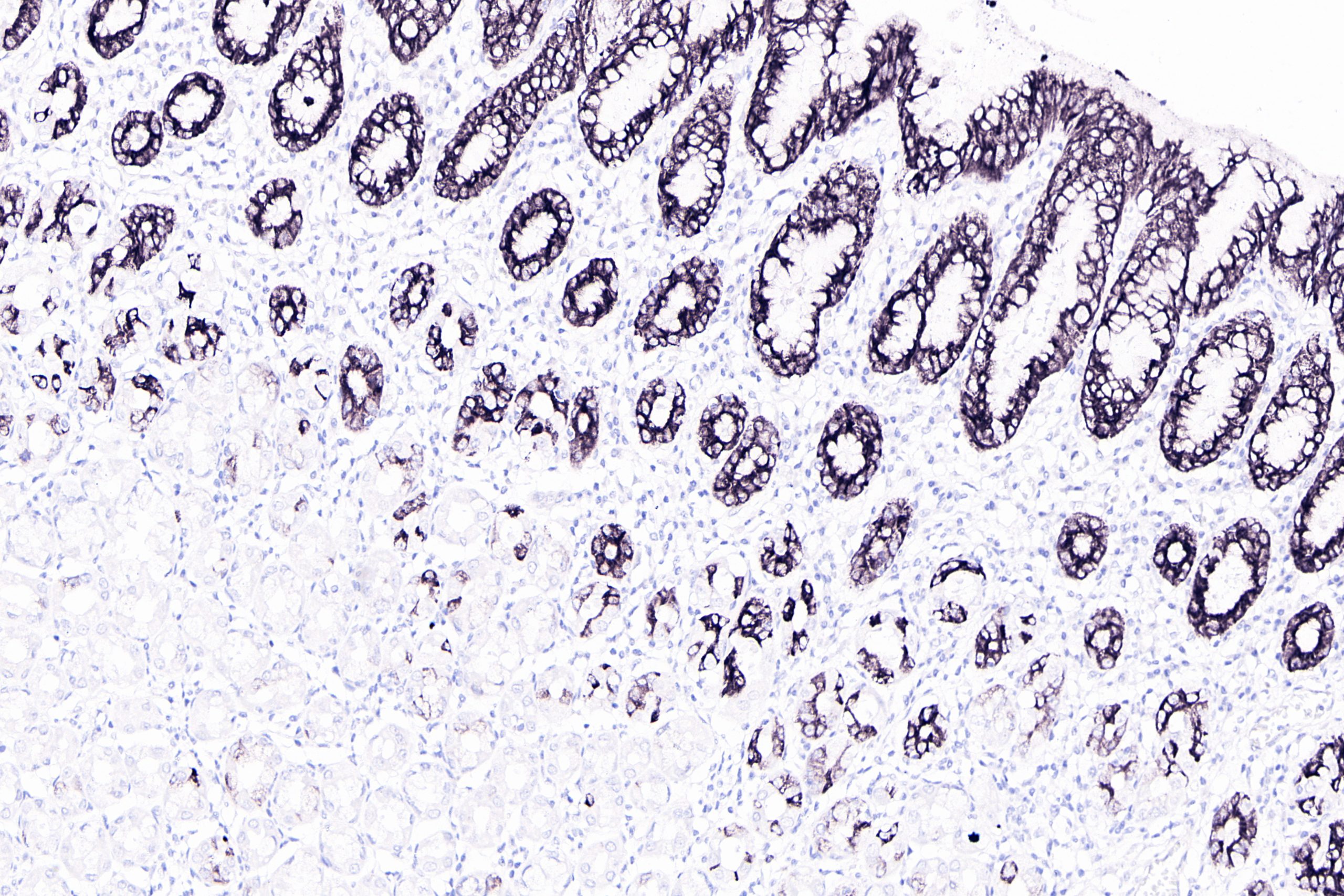
Human stoamch tissue was stained with MUC5AC Antibody
Your Request
Mouse Monoclonal Antibody to MUC5AC
Our team will review your request and respond within 1–2 business days.
Need help?
Our technical support team is here to help you with product selection, application advice, and experimental design.